

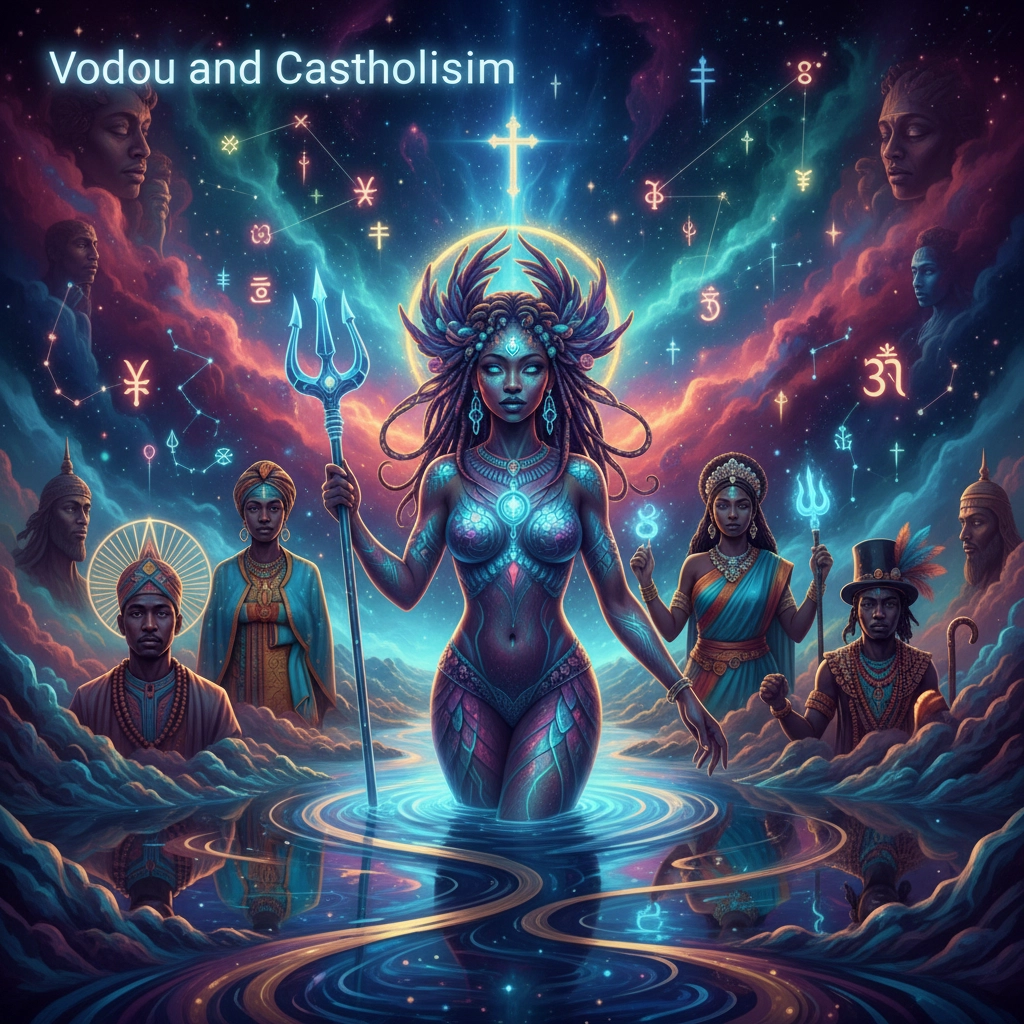
Ever wonder how two seemingly different spiritual traditions can coexist so beautifully? The relationship between Haitian Vodou and Catholicism isn't just a fascinating case study in religious syncretism: it's a masterclass in spiritual resilience, cultural survival, and the power of adaptation under oppression.
If you've been curious about how these two faith systems intertwine, or if you're a practitioner trying to understand where one ends and the other begins, you're in for a deep dive that'll challenge everything you thought you knew about religious boundaries.
When Survival Meets Spirit: The Historical Foundation
Let's get real about how this all started. We're talking about the French colonial period in Haiti, where enslaved Africans were literally forced to adopt Christianity while secretly maintaining their ancestral spiritual practices. This wasn't some peaceful religious exchange: this was survival strategy at its finest.
Picture this: You're torn from everything you know, shipped across an ocean, and told your entire spiritual worldview is "demonic." But your ancestors are still calling. Your spirits are still present. What do you do? You get creative. You adapt. You survive.

The enslaved Africans who built Haiti didn't abandon their spiritual traditions: they found ways to honor them within the imposed Catholic framework. When French colonizers demanded Christian worship, these brilliant survivors learned to see Catholic saints as faces of their beloved lwa (spirits). Not because they were confused or primitive, but because they understood something profound: the divine speaks through many forms.
The real game-changer came after the Haitian Revolution. When Jean-Jacques Dessalines proclaimed himself head of the church and started limiting priestly jurisdiction, he created space for something unprecedented. The schism with Rome meant no priests were coming from Europe to "guide" Haitian spirituality. This vacuum? It became fertile ground for genuine religious fusion.
Same God, Different Messengers: The Theological Common Ground
Here's what might blow your mind: Vodou and Catholicism actually share more theological DNA than most people realize. Both traditions center around one supreme God: Catholics call this divine source "God," while Vodou practitioners honor Bondye (from the French "Bon Dieu," meaning Good God).
But here's where it gets interesting. Both faiths recognize that this supreme divine power works through intermediary spirits. Catholics have angels and saints who intercede on behalf of humans. Vodou has the lwa: powerful spirits who serve as bridges between Bondye and the earthly realm.
Are you starting to see the connection? These aren't competing spiritual systems fighting for dominance. They're complementary frameworks that recognize the same fundamental truth: the divine is accessible through spiritual intermediaries who care about human affairs.
This parallel structure made it natural for practitioners to identify Catholic saints with Vodou lwa. Not as a "trick" to fool colonial masters, but as genuine spiritual recognition. When you understand that both Saint Peter and Papa Legba serve as gatekeepers to the spiritual realm, honoring both makes perfect sense.

Living Both Traditions: How Syncretism Actually Works
Ready to understand how millions of Haitians live this spiritual reality? It's not about compartmentalizing or code-switching between religions. It's about recognizing that spiritual truth flows through multiple channels.
Many Vodou practitioners attend Catholic mass to worship Bondye, then hold separate ceremonies to honor specific lwa. They'll baptize their children, celebrate First Communion, get married in Catholic churches, and hold masses for their deceased: all while maintaining active relationships with ancestral spirits and lwa.
This isn't spiritual confusion. This is spiritual abundance.
In Vodou ceremonies, you'll hear Catholic prayers like the Lord's Prayer and Hail Mary woven seamlessly into services for the lwa. Practitioners don't see this as mixing oil and water: they see it as honoring the full spectrum of spiritual support available to them.
Think about it: if you believed that both Catholic saints and Vodou lwa were working for your highest good, why would you limit yourself to just one set of spiritual allies?
The Tensions: When Fear Meets Faith
But let's be honest: this beautiful syncretism hasn't existed without serious pushback. Some Christian groups view Vodou as devil worship, blaming it for everything from poverty to natural disasters. After the devastating 2010 earthquake, certain Christian factions literally pointed fingers at Vodou practitioners, claiming their spiritual practices brought divine punishment.
This isn't just theological disagreement. This is spiritual violence.
The period after the Duvalier era saw church-supported "dechoukaj" (uprooting) campaigns aimed at eliminating Vodou entirely. We're talking about an estimated 100-2000 deaths of houngans (male priests) and mambos (female priests). Sacred sites were desecrated. Spiritual leaders were murdered.

The irony? Many of these attacks came from people who didn't understand that Vodou practitioners often considered themselves devout Christians. The violence wasn't just against a different religion: it was against fellow believers who honored the divine through expanded spiritual practice.
These tensions persist today. Some extremist Christian groups continue to view Vodou practitioners as demon-influenced, despite the clear theological connections between the traditions. It's a painful reminder that fear often trumps understanding, even within spiritual communities.
Recognition and Resilience: The Modern Landscape
Here's a victory worth celebrating: In 2003, President Jean-Bertrand Aristide declared Vodou an official religion of Haiti. After centuries of persecution, marginalization, and outright violence, Vodou finally received formal recognition in the country where it had always shaped art, music, and culture.
This wasn't just political symbolism. This was spiritual justice.
But the real triumph isn't governmental recognition: it's the unbroken chain of practitioners who maintained both traditions despite centuries of pressure to choose sides. Haitian communities proved that spiritual authenticity doesn't require religious purity. They showed the world that faith can be both/and instead of either/or.
Today, many Haitians continue practicing both traditions simultaneously, seeing them as complementary paths to spiritual fulfillment rather than competing belief systems. They understand something that the rest of the world is still learning: the divine is vast enough to honor multiple forms of worship.
What This Means for Modern Practitioners
If you're drawn to either tradition: or both: what can you learn from this centuries-long spiritual dance? First, recognize that authentic spirituality often involves integration rather than separation. The Haitian model shows us that honoring multiple spiritual traditions isn't spiritual greed or confusion: it's spiritual wisdom.
Second, understand that syncretism isn't about watering down traditions. It's about recognizing universal spiritual principles across cultural expressions. When Haitian practitioners see connections between Catholic saints and Vodou lwa, they're demonstrating sophisticated theological thinking, not primitive confusion.

Finally, respect the resistance embedded in these practices. Every time someone honors both Catholic saints and Vodou lwa, they're carrying forward a tradition of spiritual resilience that survived slavery, colonization, and religious persecution.
The relationship between Vodou and Catholicism isn't just about Haiti. It's about the power of spiritual communities to maintain authentic practice under impossible circumstances. It's about recognizing divine truth regardless of its cultural packaging. It's about understanding that the ancestors' wisdom doesn't disappear just because colonizers demand religious conversion.
Whether you're Catholic, Vodou, or simply spiritually curious, this syncretism offers profound lessons about faith, resistance, and the unbreakable human connection to the divine. The lwa and the saints aren't competing for your attention: they're working together for your spiritual liberation.
Are you ready to expand your understanding of what authentic spirituality can look like? The Haitian model is waiting to teach you.
