

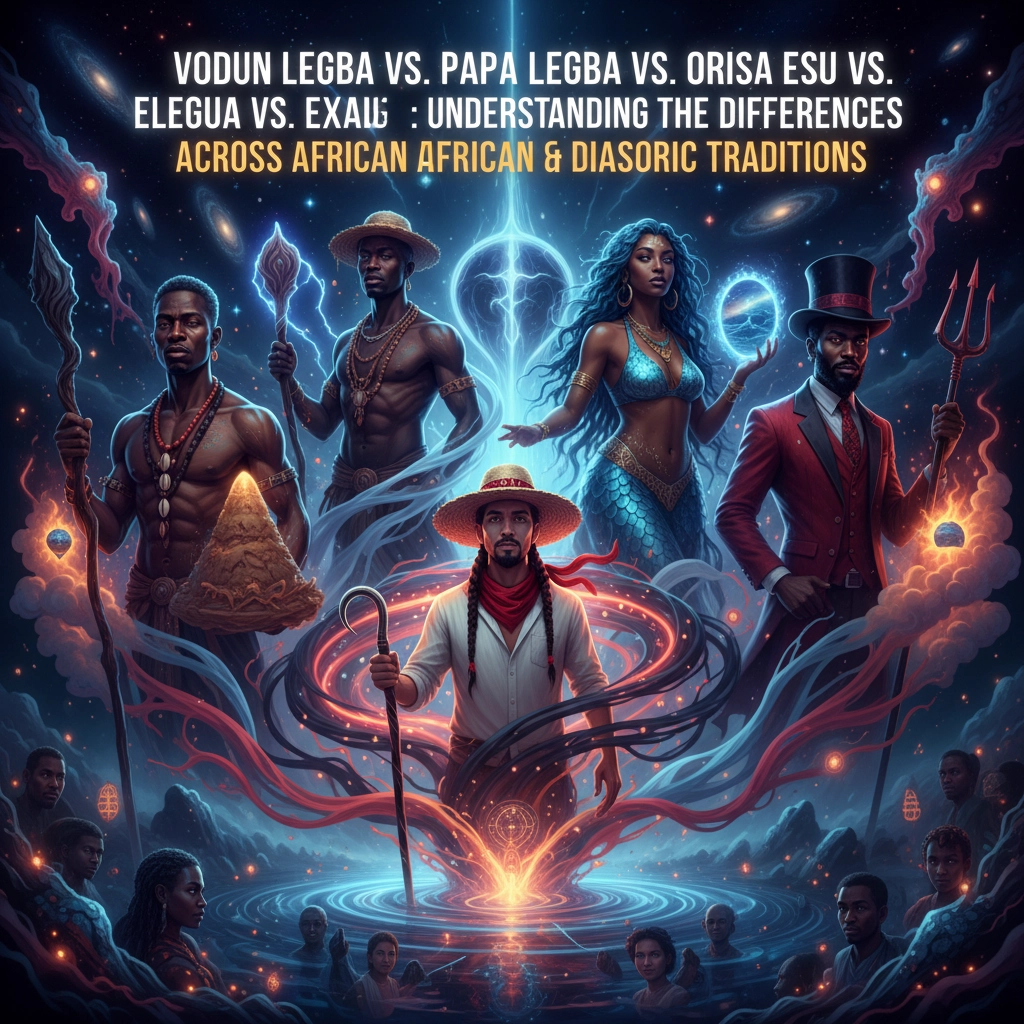
Are you tired of seeing these powerful spirits lumped together like they're the same being? Stop right there. The internet is flooded with confusion about Vodun Legba, Papa Legba, Orisa Esu, Elegua, and Exu, and honestly, it's doing a disservice to every single one of these traditions.
Here's the truth: These are distinct spiritual entities from separate religious systems. Yes, they share some surface-level similarities: crossroads, keys, messages, being "first" in ceremonies: but treating them as interchangeable is like saying all water spirits are Mami Wata. It's reductive, inaccurate, and frankly disrespectful.
Ready to get this straight once and for all? Let's break down who's who, where they come from, and why these distinctions actually matter for your spiritual practice.
Vodun Legba: The West African Original
Let's start where it all began: West Africa. In traditional Vodun (practiced in Benin, Togo, and parts of Nigeria), Legba is a vodun (divine force/spirit) who controls communication between the human and spirit worlds. This isn't your Haitian Papa Legba or your Cuban Elegua: this is the root source.

Vodun Legba appears as a clay mound, often phallic in nature, positioned at crossroads, market entrances, and compound doorways. He's not just a guardian: he's the cosmic translator. Nothing reaches the other voduns without his permission. In Fon cosmology, he's Mawu-Lisa's (the supreme deity) messenger, the one who speaks all languages and understands all intentions.
Key attributes:
- Clay mounds with cowrie shells
- Positioned at literal crossroads and thresholds
- Speaks all languages, including those of spirits
- Controls access to divine communication
- Often represented with exaggerated masculine fertility symbols
The offerings? Palm wine, red palm oil, corn meal, and sometimes kola nuts. But here's what many people miss: Vodun Legba operates within a completely different theological framework than what developed in the Americas. He's not syncretized with Catholic saints, and his worship doesn't involve the ceremonial structures you'll find in Caribbean or Brazilian traditions.
Papa Legba: The Haitian Vodou Lwa
Now we're crossing the Atlantic. Papa Legba is a lwa (not a vodun, not an orisha) in Haitian Vodou. The enslaved Africans brought memories of Legba to Haiti, but centuries of evolution, Catholic syncretism, and new spiritual influences created something distinct.
Papa Legba in Vodou appears as an old man with a cane, often limping, sometimes with dogs at his side. He's been syncretized with Saint Peter (holder of the keys to heaven) and Saint Lazarus. He opens the spiritual gates for all ceremonies: no lwa can be reached without his permission.
Key attributes:
- Elderly man with walking stick or crutches
- Keys, crossroads, and doorways
- Syncretized with Catholic saints
- Opens ceremonies and closes them
- Guardian of the home and protector of children
The vèvè (sacred symbol) for Papa Legba features crossroads with keys, sometimes a cane. His colors are typically red and black, though some houses use different combinations. Offerings include candy, rum, coffee, and tobacco.
Here's where people get confused: Papa Legba operates within Vodou's unique spiritual hierarchy and ceremonial structure. He's not an orisha you "crown" or a vodun you approach the same way. He's a lwa you serve within Haiti's specific religious framework.
Orisa Esu: The Yoruba Divine Messenger
Switching gears completely. In traditional Yoruba religion (Isese), Esu is an orisha: a divine force of nature with specific responsibilities in the cosmic order. Esu is not evil (despite colonial Christian demonization), not mischievous for fun, and definitely not the same as Papa Legba or Vodun Legba.
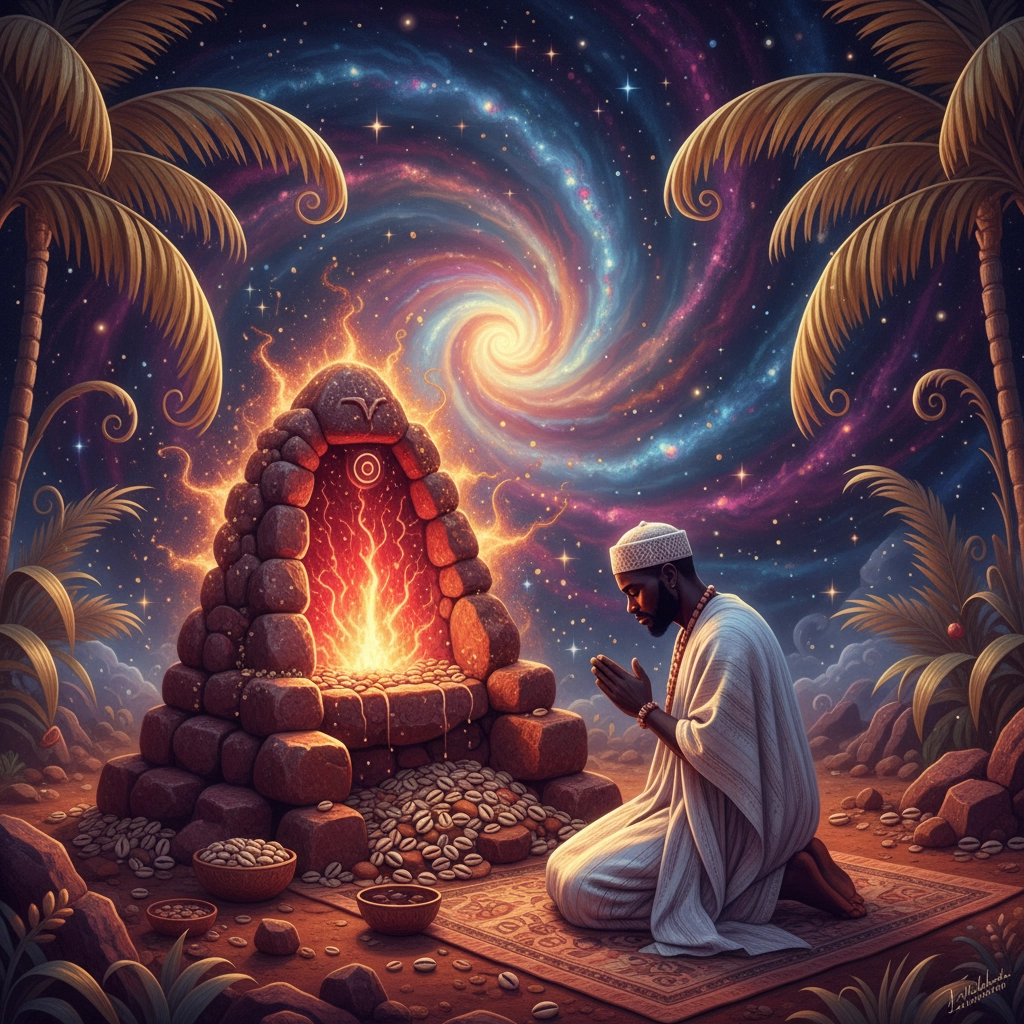
Esu is the divine messenger, the one who carries our prayers to Olodumare (the Supreme Creator) and brings back responses. He's also the orisha of potential, possibilities, and crossroads: but in the Yoruba sense of spiritual choice and destiny, not just literal road intersections.
Key attributes:
- Laterite stone or cowrie shells
- Red and black colors (primarily)
- Palm nuts, palm oil, rum, cigars as offerings
- Multiple "paths" or aspects (Esu Odara, Esu Laroye, etc.)
- Guardian of homes, placed behind doors or at entrances
In traditional Yoruba practice, Esu receives offerings first in any ceremony. His shrine (called an Esu) consists of laterite stones, cowrie shells, and iron implements. The relationship with Esu is built over time through consistent offerings and respectful communication.
Stop confusing this with Santeria's Elegua. While Cuban Santeria preserved much Yoruba wisdom, centuries of evolution in Cuba created variations. Traditional Yoruba practitioners work with Esu directly, not through Catholic syncretism or Cuban adaptations.
Elegua: The Cuban Santeria Adaptation
Here's where things get interesting. In Cuban Santeria (Lucumi), Elegua represents the Cuban evolution of Yoruba Esu worship. The enslaved Yoruba people adapted their practices to survive in Cuba, creating something that honors the original while responding to new circumstances.
Elegua in Santeria has been syncretized with the Holy Child of Atocha or Saint Anthony. He's often represented as a child or young man, sometimes mischievous, always requiring careful attention. In many Santeria houses, Elegua is received as a cement head with cowrie shells for eyes and mouth, living behind the front door.
Key attributes:
- Cement heads with cowrie shell features
- Red and black colors (sometimes yellow and green)
- Candy, toys, rum, cigars as offerings
- Multiple caminos (paths) like Esu Laroye, Esu Ayelu
- Syncretized with Catholic child saints
Here's the crucial difference: Cuban Elegua operates within Santeria's specific initiatory structure, including ceremonies like making saint (Kariocha), godparent relationships, and ile (house) hierarchies that don't exist in traditional Yoruba practice. The relationship dynamics, ceremonial obligations, and spiritual expectations differ significantly.
Exu: The Brazilian Transformation
Brazilian traditions took another path entirely. In Candomble, Exu maintains closer ties to West African concepts, but in Umbanda and especially Quimbanda, Exu evolved into something distinctly Brazilian.
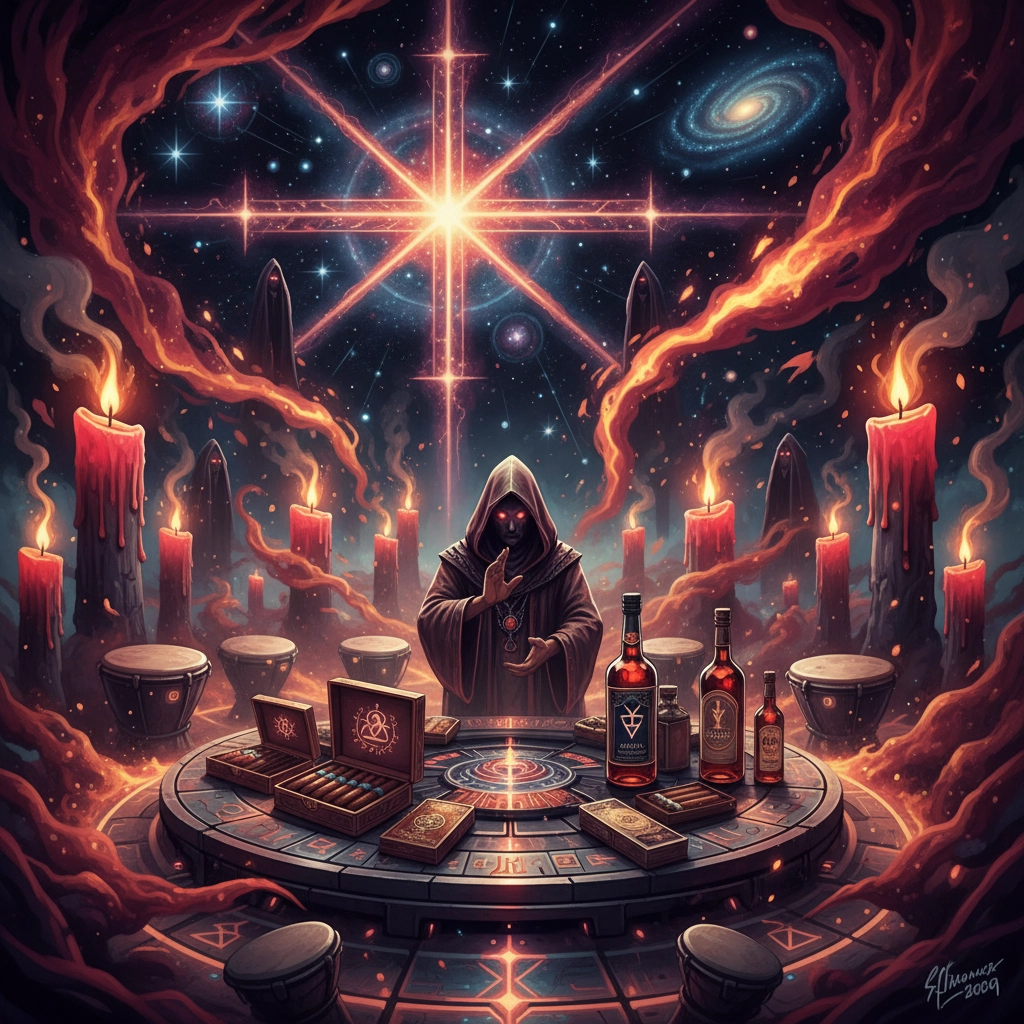
In Quimbanda, Exus are considered spirits of the dead who work magic, often specializing in love, protection, and justice work. They're not orishas in the Yoruba sense: they're elevated human spirits with specific powers and personalities. Some are former sorcerers, warriors, or wise people who chose to remain active in the spiritual realm.
Key attributes:
- Human spirits, not divine forces
- Red and black colors, sometimes with gold
- Cigars, cachaca, red wine, spicy foods
- Work primarily with magic and problem-solving
- Have individual names and personalities (Exu Tranca Rua, Exu Seven Crossroads, etc.)
The relationship with Quimbanda Exus is contractual: you ask for specific help, make specific offerings, and maintain ongoing relationships based on mutual respect and exchange. This is completely different from the devotional relationships found in Yoruba, Vodun, or even Santeria traditions.
Why The Confusion Exists (And Why It Matters)
You're probably wondering, "If they're so different, why does everyone mix them up?" Fair question. Here's what happened:
Colonial erasure and missionary demonization lumped all African spiritual practices together as "devil worship." Academic oversimplification treated diverse African traditions as variations of the same thing. New Age appropriation cherry-picked elements from multiple traditions without understanding their contexts.
Modern internet spirituality made it worse by creating generic "crossroads deity" content that ignores cultural specificity. Add some poorly researched books, a few TikTok spiritual influencers, and boom: complete confusion.
Why does this matter for your practice? Because approaching Vodun Legba with Santeria protocols won't work. Offering Papa Legba the same items you'd give Quimbanda Exu might offend rather than honor. Trying to "work with" traditional Yoruba Esu without proper cultural education and community guidance shows disrespect for centuries of preserved wisdom.
Respectful Approach to Each Tradition
For Vodun Legba: Connect with authentic Vodun practitioners in West Africa or legitimate Vodun houses in the diaspora. This isn't a tradition you can learn from books or online courses. It requires community, proper initiation, and years of learning.
For Papa Legba: Find a legitimate Vodou house (sosyete) with proper lineage. Vodou is community-based: solo practice missing the point entirely. Learn the songs, understand the lwa family structures, and build relationships within the tradition.
For Orisa Esu: Study with traditional Yoruba priests (Babalawo or Iyalawo) or legitimate Isese practitioners. This means learning Yoruba language basics, understanding Ifa philosophy, and respecting the cultural context. Don't try to separate the orisha from Yoruba culture.
For Santeria Elegua: Connect with a legitimate ile (Santeria house) with proper lineage. This involves godparent relationships, step-by-step initiation processes, and community obligations. Santeria isn't a solo path: it's about spiritual family.
For Brazilian Exu: Work with experienced Quimbanda or Umbanda practitioners who can teach proper protocols. Brazilian traditions have their own cultural contexts, music, and ceremonial requirements that need to be learned properly.
The Bottom Line
Stop treating these powerful spiritual forces like they're interchangeable parts in some generic "crossroads magic" system. Each represents centuries of preserved wisdom, cultural adaptation, and spiritual evolution within specific communities.
Your ancestors didn't preserve these traditions through slavery, colonization, and cultural persecution just so you could mix-and-match spiritual practices like you're ordering from a religious menu. Show some respect.
Want to work with crossroads energy? Pick one tradition. Learn it properly. Build authentic relationships within that community. Honor the cultural context that preserved these practices for generations.
Ready to stop spiritual window shopping and commit to authentic practice? The crossroads are waiting: but you've got to choose your path and walk it with integrity.
