

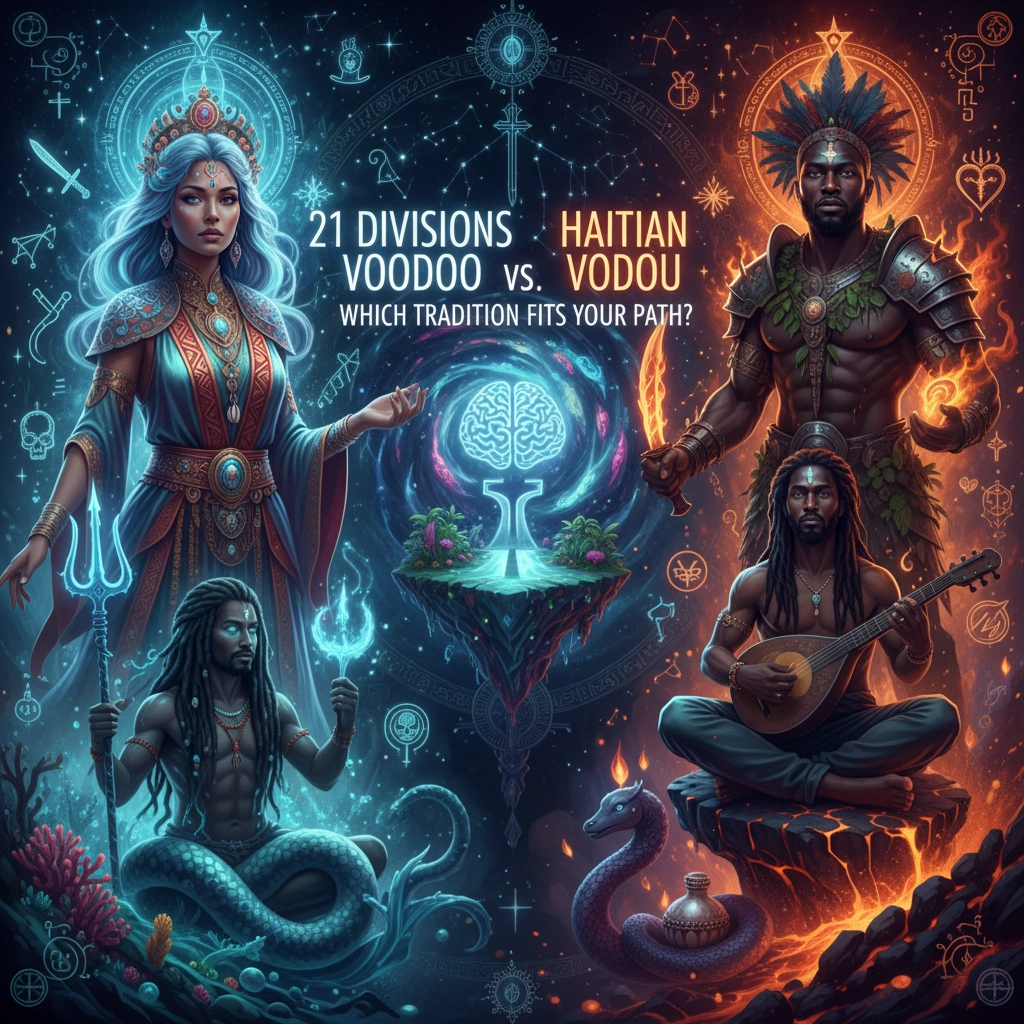
Are you feeling called to Caribbean spiritual traditions but confused about which path to take? You're not alone. Many people discover they're drawn to both Dominican Voodoo (Las 21 Divisiones) and Haitian Vodou, but don't know how to choose between them. Here's the truth: these traditions share deep roots but have evolved into completely different spiritual experiences. Understanding their differences will help you find your authentic spiritual home.
Both traditions emerged from the same African diaspora roots, but they've grown into distinct practices with different approaches to spirit work, community, and healing. Let's break down what makes each tradition unique so you can make an informed choice about your spiritual journey.
Understanding Dominican Voodoo (Las 21 Divisiones)
Dominican Voodoo operates like a spiritual democracy. Think of it as the more flexible, adaptable cousin in the Caribbean spiritual family. The name "21 Divisions" comes from the way spirits (called lwa or misterios) are organized into 21 hierarchical groups: Leguas, Ogunes, Rodas, Locos, Guedes, Petros, Simbis, Locomis, Zombies, Indians, Nagos, Congos, and others.
What makes this tradition fascinating is its incredible flexibility. Unlike other structured spiritual systems, Dominican Voodoo doesn't have fixed doctrine or defined temples and ceremonies. This means you have multiple ways to connect with spirits – through music, tarot cards, palm reading, shells, or whatever method feels right for you.
Here's where it gets interesting: when you call on a specific spirit in Dominican Voodoo, you might get someone completely different showing up. It's like calling your friend Maria but getting a call back from her sister instead. This unpredictability isn't a bug – it's a feature. The spirits decide who you need to hear from, not necessarily who you think you want to talk to.

The tradition blends Catholic saints, African orishas, Taíno indigenous spirits, and influences from Santeria and Espiritismo. This syncretism happened under Spanish colonial rule, creating a unique spiritual language that speaks to people from diverse backgrounds. Major spirits include Belíe Belcán, Anaísa Pie, El Barón del Cementerio, Ogún Balenjod, Marta la Dominadora, Gran Toro, and Ti Jean Petró.
Strengths of Dominican Voodoo:
- Extremely flexible and adaptable to personal style
- Multiple methods for spirit communication
- Less rigid protocol requirements
- Welcomes spontaneous spiritual experiences
- Strong integration with Catholic and other Caribbean traditions
- Gender equality in spiritual leadership (both houngan and mambo)
Considerations:
- Can feel unpredictable or chaotic for structured personalities
- Requires comfort with spiritual surprises
- Less formal training structure
- May lack consistency some practitioners prefer
Understanding Haitian Vodou
Haitian Vodou is like the elder sibling who's had centuries to perfect their craft. This tradition demands respect through specific protocols and offers predictable, powerful results when you follow the rules correctly.
In Haitian Vodou, precision matters. Each spirit (lwa) requires particular music, specific dances, and ceremonial elements to manifest properly. When you call Papa Legba using the right songs and protocols, Papa Legba shows up – not his cousin, not a random spirit, but exactly who you invited. This reliability creates a controlled, predictable spiritual experience.
The tradition centers around Gran Met (the Great Master) as the supreme deity, with the lwa serving as intermediaries. Haitian Vodou developed under French colonial influence, maintaining stronger connections to traditional African spiritual frameworks while developing its own distinct identity through the crucible of revolution and independence.

Haitian Vodou features fixed doctrine, defined temples (peristyles), and established ceremonies that provide clear guidelines for practitioners. The spirits are traditionally organized into Rada (cool, healing spirits), Petwo (fiery, revolutionary spirits), and Gedé (death and fertility spirits) nations, each with specific characteristics and requirements.
Strengths of Haitian Vodou:
- Structured, time-tested spiritual framework
- Predictable spirit communication and manifestation
- Clear ceremonial guidelines and protocols
- Strong community and mentorship traditions
- Deep historical and cultural authenticity
- Comprehensive healing and magical systems
Considerations:
- Requires strict adherence to protocols
- More demanding learning curve
- Less flexibility for personal interpretation
- Can feel restrictive for free-spirited practitioners
- Requires commitment to formal training
Side-by-Side Comparison
| Aspect | Dominican Voodoo (21 Divisions) | Haitian Vodou |
|---|---|---|
| Flexibility | Highly flexible, no fixed doctrine | Structured with established protocols |
| Spirit Invocation | Multiple methods (music, tarot, shells, palms) | Specific songs, dances, and ceremonies required |
| Spirit Response | Any spirit may manifest when called | Called spirit specifically appears |
| Learning Structure | Informal, self-directed exploration | Formal initiation and mentorship system |
| Community | Individual-focused with loose networks | Strong communal temple structure |
| Cultural Background | Spanish colonial, Catholic, Santeria influences | French colonial, African traditional framework |
| Predictability | Spontaneous, surprise-driven | Consistent, protocol-based results |
| Accessibility | More accessible for beginners | Requires serious commitment and study |

Which Tradition Calls to You?
Choose Dominican Voodoo (21 Divisions) if:
You're someone who thrives on flexibility and spiritual adventure. Maybe you're already drawn to multiple spiritual systems, or you love the idea of spirits having their own agenda about what you need to hear. Dominican Voodoo suits practitioners who want freedom to explore different methods of spirit communication without feeling locked into rigid protocols.
This path works particularly well if you have connections to Spanish-speaking Caribbean culture, Catholicism, Santeria, or Espiritismo. You'll appreciate the tradition's openness to syncretism and its welcoming attitude toward spiritual experimentation. If you're comfortable with unpredictability and actually enjoy spiritual surprises, this tradition offers an exciting, less constrained approach to spirit work.
Choose Haitian Vodou if:
You prefer structure, consistency, and time-tested methods. Maybe you're someone who wants to know exactly what to expect from your spiritual practice, or you're drawn to the deep historical authenticity of traditional African diaspora religion. Haitian Vodou appeals to practitioners who value ceremonial precision and appreciate knowing that centuries of refinement have perfected these spiritual technologies.
This tradition suits people willing to commit seriously to formal training and community involvement. If you're looking for a spiritual practice with clear mentorship paths, established initiation levels, and a strong sense of belonging to an ancient tradition, Haitian Vodou provides that stability and depth.
For Spiritual Beginners: Start Here
If you're new to Caribbean spiritual traditions, Dominican Voodoo might offer a gentler entry point due to its flexibility and lower barrier to initial exploration. You can begin connecting with spirits through methods that feel comfortable – maybe starting with candle work and prayer, or exploring divination with cards or shells.
However, don't let accessibility fool you into thinking either tradition is "easy." Both require serious respect, ethical practice, and genuine spiritual development. The difference is that Dominican Voodoo allows more room for exploration while you're learning, while Haitian Vodou requires more formal preparation before deep practice begins.

Making Your Decision
Here's what you need to ask yourself: Do you want a spiritual practice that feels like jazz improvisation or classical symphony? Both are beautiful, both are powerful, but they require different temperaments and offer different experiences.
Consider your learning style, cultural background, and spiritual goals. Are you drawn to the spontaneity and flexibility of Dominican Voodoo, or does the structure and predictability of Haitian Vodou feel more aligned with your needs? There's no wrong choice – only the choice that serves your authentic spiritual development.
Remember that whichever tradition you choose deserves your full respect and serious commitment. These aren't spiritual hobbies or aesthetic choices – they're living religious traditions with deep roots and powerful spirits who expect integrity from their practitioners.
Both traditions offer profound healing, spiritual growth, and connection to ancestral wisdom. The question isn't which one is "better" – it's which one calls to your spirit and aligns with how you naturally connect to the divine. Trust your intuition, do your research, and honor whichever path chooses you.
Your spiritual ancestors are waiting to guide you, regardless of which door you choose to walk through. The most important step is choosing to walk through one of them with respect, authenticity, and genuine commitment to your spiritual growth.
